Suggested Itineraries
- Home
- Suggested Itineraries
- Trace the Umi-no-tami and Kuniumi Story in northern Awaji Island
― COURSE ❶ ―Trace the Umi-no-tami and Kuniumi Story in northern Awaji Island
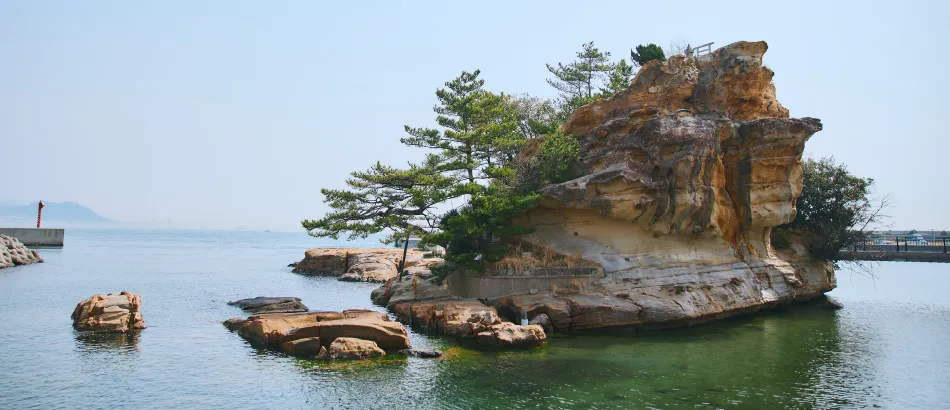
Cross the Akashi Kaikyo Bridge, enjoy its stunning scenery, and explore the area's historic landmarks. This course offers an opportunity to appreciate the beauty of nature, learn about the lifestyle of the people during the Yayoi period, and visit Izanagi-jingu Shinto Shrine—Awaji-no-Kuni Ichinomiya, the highest-ranking shrine on Awaji Island, affectionately known as “Ikkusan” among the island's residents.
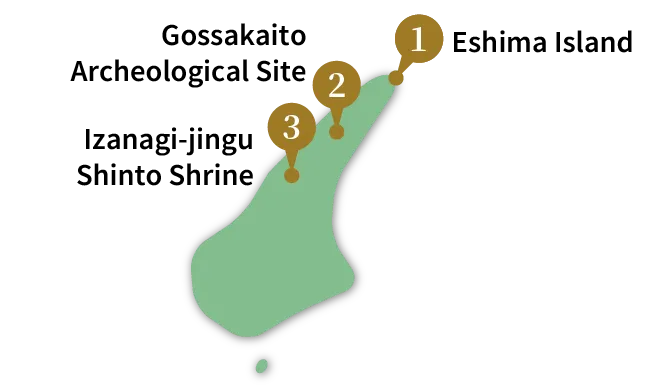
1Eshima Island

An island floating just off the northern tip of Awaji Island, believed to be one of the legendary sites of Onokoro Island, which is mentioned in the Kuniumi Story. Originally connected to the land, it gradually transformed into the island it is today due to wave action. At the top of the island stands a stone monument, said to have been dedicated to Matsuomaru, who became a human sacrifice to save others who were about to be sacrificed when Taira no Kiyomori repaired the port of Owada-no-tomari. Today, Eshima remains one of Awaji Island's most celebrated scenic attractions, and it is designated a place of scenic beauty by the prefecture. The entire island is illuminated at night.
*Eshima Island is inaccessible due to safety concerns
Iwaya, Awaji City, Hyogo Prefecture
Eshima Island[Google map]
+81-799-72-3420
(Awaji Island Tourist Association Iwaya Information Center)
20 minutes by car (including toll sections)
2Gossakaito Archeological Site
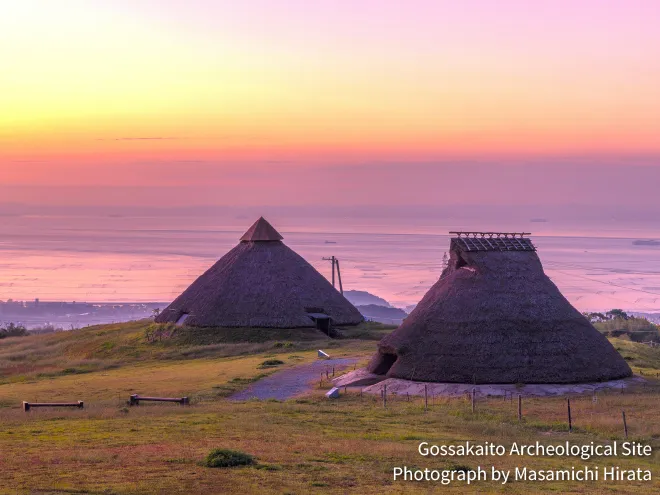
This is the site of a hilltop settlement believed to have produced ironware during the late Yayoi period, roughly 1,800 to 1,900 years ago. Excavations revealed the remains of 23 pit buildings, 12 of which were blacksmithing workshops producing ironware. Few sites from this period—when iron was scarce—have yielded so many workshops. Moreover, production continued at this location for more than a century, making Gossa Kaito an exceptionally important site for understanding society at the time.
The site is designated as a national historic site, and the excavated items are designated as tangible cultural properties of the prefecture.
1395-3 Kurodani, Awaji City
Gossakaito Archeological Site[Google map]
+81-799-70-4217
(Activity Center of Gossakaito Archaeological Site)
20 minutes by car
3Izanagi-jingu Shinto Shrine
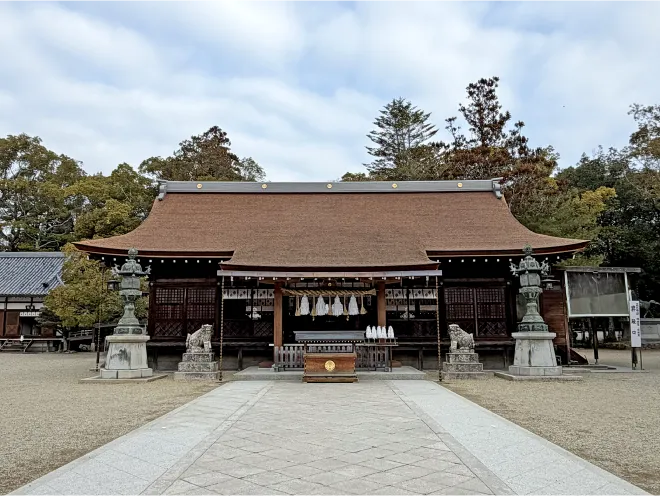
According to the oldest Japanese texts, the Kojiki (Records of Ancient Matters) and the Nihonshoki (Chronicles of Japan), the Shinto deity Izanagi-no-Mikoto, who accomplished all divine tasks, beginning with Kuniumi (the creation of Japan), handed over the great task of governing the realm to his daughter, Amaterasu Omikami. He then established the Kakuri-no-Miya (Hidden Palace) at Taga on Awaji Island, which he had first created, and spent the rest of his life there. A mausoleum was built at the site of his residence, and Izanagi-jingu Shinto Shrine is said to have originated there as Japan's oldest shrine. Locally, the shrine is affectionately known as “Ikkusan”and is also revered under other titles, Hi no Wakamiya, Awajishimagami, Taga Myojin, and Tsuna Myojin.
